
Contact us

The Conversation Happening at the Top: What Senior Marketing Leaders Are Navigating Right Now
There is a shift happening in how organizations make decisions, and marketers and communicators are at the center of it.
For too long, communications and marketing leaders were brought in after the strategy was set, after the product was built, or after the announcement was drafted. Their job was to package decisions that had already been made.
The organizations navigating disruption well have figured something out: marketing and communications leaders belong at the table from the beginning, shaping strategy before decisions are finalized rather than packaging them after the fact.
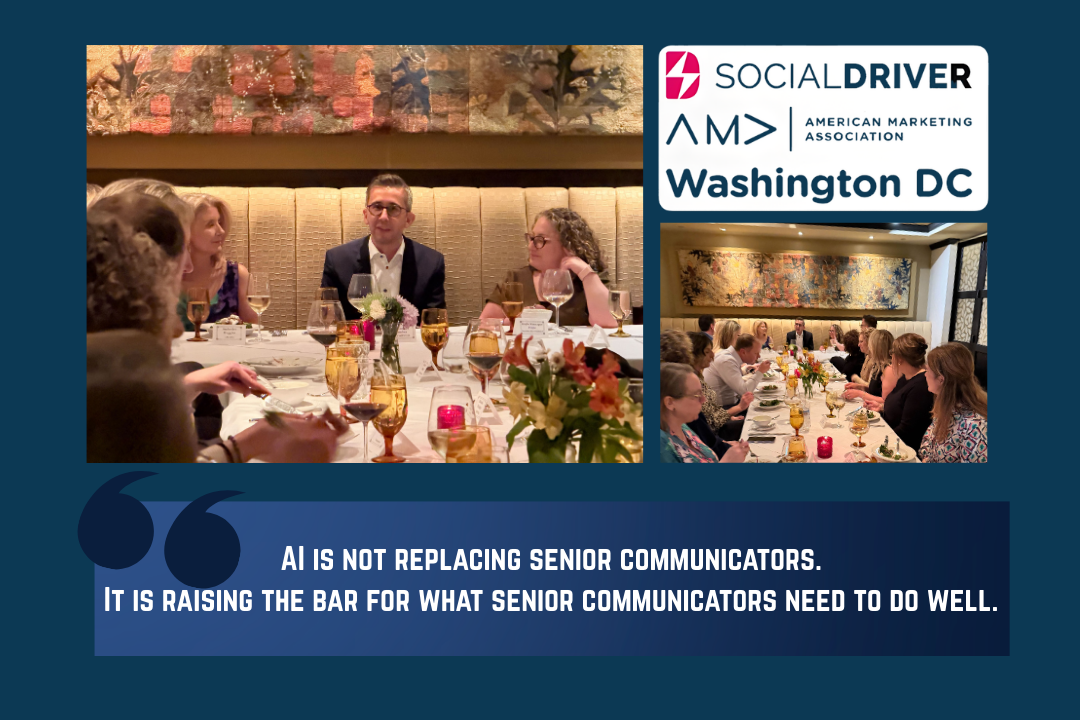
That is the conviction behind the work Social Driver does, and it is what brought senior marketing and communications leaders together at the AMADC Executive Marketing Leadership Dinner this month. As Presenting Sponsor of the AMA DC Executive Marketer Leadership Circle, Social Driver convenes these gatherings because the conversations that actually shape how the field moves forward rarely happen on a stage. They happen when the right people are in the same room and the agenda is cleared enough for honest conversation.
What follows is not a transcript but a distillation of what senior leaders at the top of their field are wrestling with right now, and what the conversation revealed about where the discipline is heading.
AI Is Already Here. The Question Is How to Lead Through It.
Nobody in the room was debating whether AI matters. That conversation is over. What senior marketing leaders are actually grappling with is harder: how to make consequential decisions about tools, talent, and workflows when the landscape is changing faster than any organization can formally evaluate it.
The leaders doing this well are not waiting for a policy to hand down. They are building enough internal fluency to make good judgment calls, setting guardrails that leave room to move, and staying close enough to their teams to know where the real friction is. The ones struggling are often waiting for certainty that is not coming.
The honest version of the conversation was this: AI is not replacing senior communicators. It is raising the bar for what senior communicators need to do well, and doing it faster than most organizations are ready for.
Influence Is Being Renegotiated.
Several leaders described a version of the same experience: relationships and channels that reliably built influence five years ago are working differently now. Media ecosystems have fragmented. Trust in institutions has eroded. The audiences that marketing and communications leaders need to reach are more skeptical and harder to move.
What is filling the gap, in many cases, is personal credibility. Leaders who show up consistently, who have a clear point of view, and who are willing to engage in real conversations rather than polished announcements are earning a different kind of authority. It does not scale the same way as a media placement or a campaign. But it holds in ways that traditional influence infrastructure increasingly does not.
The implication is significant: senior marketing leaders may need to become visible advocates for their organizations in ways that were once considered optional. For many, that is a meaningful shift in role.
Policy Is Moving. Marketing Strategy Has to Move With It.
Washington is never static, but the pace and scope of policy change right now is putting real pressure on organizations that need to stay relevant to decision-makers. The leaders at the dinner were navigating this in different ways, but the common thread was that reactive communications is not sufficient anymore.
The organizations positioned well are the ones that have built standing relationships, that have a clear and credible voice on their issues, and that can move quickly when the moment requires it. Credibility built in advance is the only kind that works when you need it fast.
What Leadership at the Top Actually Requires Right Now
If there was a single theme running through the dinner, it was this: the demands on senior marketing and communications leaders have expanded significantly, and the gap between what the role used to require and what it requires now is wider than most job descriptions reflect.
The leaders navigating this well are the ones who have gotten clear on what they can and cannot do alone, who are investing in the relationships and the infrastructure that let them move quickly, and who have stayed honest with themselves and their organizations about where the real risks are.
That kind of honesty is harder to perform than to practice. But it is exactly the kind that earns trust at the level where it matters.


.png)
)%20(1).png)
