
Contact us

By Anthony Shop and Kristina Saccone
Imagine this: your organization has spent months producing high-quality research on a critical public issue. You publish, promote, and brief your stakeholders. Then something remarkable happens—people start repeating your message. Community leaders cite your findings. Advocates reference a key stat. Journalists paraphrase your conclusions.
It’s working.
But when you check your web analytics, there’s… nothing. No traffic spike. No referral lift. No trace that your work is behind the understanding that’s spreading.
Instead, the journey looked like this: someone typed a question into Google or ChatGPT, skimmed a summary pulled from your content, and walked away better informed—without ever clicking your link. Or worse: a generative engine shared a misleading answer from a source with lower standards and no fact-checking, simply because its structure was easier for machines to summarize.
So we must ask a new strategic question:
Is influence without attribution still influence?
For public-interest organizations—think tanks, advocacy groups, foundations, academic centers, coalitions, and mission-driven nonprofits—the stakes are especially high. We don’t sell products. We sell ideas. And in today’s digital environment, truth no longer spreads through clicks alone. It spreads through summaries, snippets, and answers—many of which never link back to us.
That is why search itself has changed, and why communicators who shape public understanding must evolve from Search Engine Optimization (SEO) to Generative Engine Optimization (GEO).
To explore this shift and its implications for leaders who inform public opinion, The National Digital Roundtable and The Aspen Institute convened leaders in public affairs, communications, and digital technology to discuss the challenges and opportunities facing those who are charged with influencing public opinion and public policy. What follows is not a recap of that conversation but an evergreen guide for the new reality: one where the goal is no longer just being found—it is being understood and trusted, even when attribution disappears.
What Changed? From “Search and Click” to “Ask and Summarize”
For more than two decades, the web followed a simple pattern:
That era is ending.
Today, people increasingly ask questions instead of searching keywords, and engines increasingly answer instead of linking. Generative engines—ChatGPT, Perplexity, Google SGE, and others—now sit between the question and the original source. They summarize, paraphrase, and package content into instant responses, creating a “zero-click” environment where visibility no longer relies on pageviews.
In this world:
This shift doesn’t make SEO obsolete, but it does make SEO incomplete. GEO expands the mandate.
Search Engine Optimization helps machines find your content.
Generative Engine Optimization helps machines summarize your content accurately.
SEO asks:
“Can people find us when they look?”
GEO asks:
“Do people understand us when they’re shown a summary?”
For organizations that work in policy, research, and public affairs, this distinction is existential:
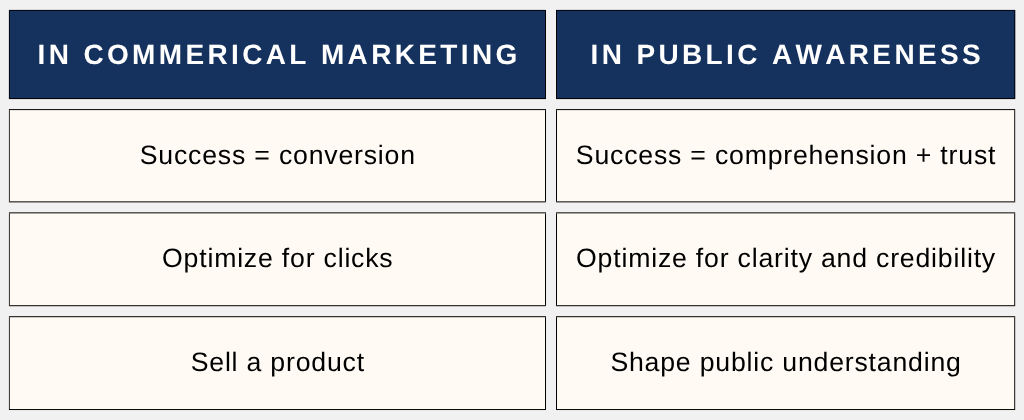
This is why SEO tactics borrowed from brand marketing fall short for mission-driven organizations. We are not trying to be the catchiest or most clickable. We are trying to be the most accurate, trusted, and clear source when the public—and now AI systems—ask questions that shape opinion and policy.
AI Is the New Browser: Visibility Without Visits
Generative engines are rapidly becoming the first-touch interface with knowledge, especially among younger audiences and busy professionals. Increasingly, users:
This introduces a hard truth: influence can now happen without a website visit.
That means:
This is why attribution can no longer be our north star. Understanding must be.
In GEO environments, generative engines reward signals of authority, clarity, and credibility, not just backlinks or keywords. Three forces are reshaping what earns visibility:
Thus, PR, thought leadership, and structural clarity are no longer separate strategies. They are GEO strategies.
In a summarize-first environment, well-structured content is a competitive advantage. Organizations should:
In this new era, if an AI cannot summarize your page accurately, the page is the problem, not the AI.
Many organizations are panicking about declining traffic—but traffic is no longer an accurate proxy for influence. GEO reality requires new success indicators, such as:
Funders and boards will need education on this shift. Communicators must lead that conversation, not wait for it.
In GEO environments, misinformation moves faster than corrections. We heard examples of:
To counter this, organizations are adopting misinformation playbooks, including:
When accuracy becomes optional, clarity becomes an act of leadership.
Public-interest communicators must be both savvy and responsible. That means:
The goal is not just to “show up.” The goal is to deserve to be summarized.
The landscape will keep shifting. Three trends will define the next chapter:
Those who experiment early will adapt fastest.
To shape opinion in a summarize-first world, mission-driven teams must:
This is not “extra work.” It is the work.
We convened this discussion because we believe the future of public awareness demands a new mindset—one rooted in clarity, credibility, and adaptability.
If generative engines will increasingly shape what the public sees, then mission-driven communicators must shape what generative engines learn.
We can no longer measure our impact solely by who lands on our website. The more important question is: “Did our message reach the public clearly, accurately, and in time?” When influence happens without attribution, reputation must be earned through trust, clarity, and consistency—again and again.
The summarize era is here. We cannot out-code the machines. But we can out-communicate them.
Special thanks to the communicators, strategists, and leaders who joined us from: The Aspen Institute; Social Driver; Bainum Family Foundation; CivicAI Strategies; Society for Science; AAAS; Embassy of the Republic of Poland in the U.S.; Healthcare Leadership Council; Carnegie Endowment for International Peace; NEA Foundation; Migration Policy Institute; American Association of Immunologists; Greater Washington Partnership; The Brookings Institution
Kristina Saccone is director of creative services at The Aspen Institute.
Anthony Shop is chairman of the National Digital Roundtable and co-founder and Chief Strategy Officer of Social Driver.
Editorial Transparency Note: In the spirit of this topic, we used AI tools to help us turn our detailed roundtable notes—including contributions from participants—into a clear, structured piece. We wanted to follow our own advice: making the content digestible for both humans and generative engines, while keeping the thinking, judgment, and final writing in human hands.


.png)
)%20(1).png)
.png)