
Contact us

Your Logo Isn’t Building Trust. Your People Are.
Anthony Shop opened the Association Leader Power Breakfast with that idea. But the strongest evidence for it came after the event ended.
In the days following the breakfast, attendees filled LinkedIn with their own perspectives on trust, storytelling, networking and leadership. They did not simply repost an organizational recap. They shared what challenged them, credited the people who shaped their thinking and added lessons from their own experience.
In other words, they became the trusted voices carrying the conversation forward.
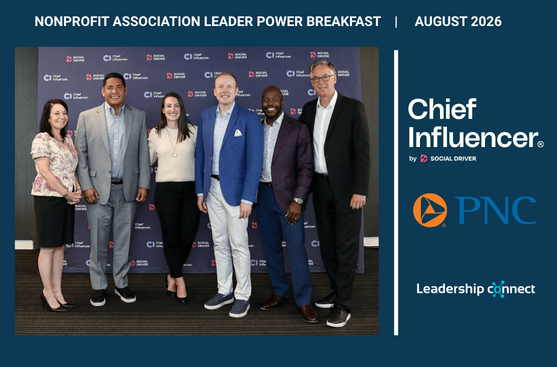
More than 100 association and nonprofit leaders gathered at PNC Bank’s Washington, D.C. offices for the breakfast, co-hosted by Social Driver, PNC and Leadership Connect. Anthony moderated a panel featuring Bryan Myers, CEO of [solidcore]; Rudy Soto, Executive Director of the National American Indian Housing Council; and Erica Pyatt of LinkedIn.
Their conversation offered a useful blueprint for leaders who know they should be more visible but are not sure what to say, how personal to get or whether anyone wants to hear from them.
Many organizations look outward when they want to build influence. They search for prominent partners, celebrity advocates or outside experts who can introduce the mission to a larger audience.
But influence often starts much closer to home.
Your organization already has people with expertise, relationships and firsthand knowledge that audiences may find more credible than a polished institutional statement. Those voices may belong to the CEO, but they may also come from program directors, policy experts, researchers, frontline employees, members or volunteers.
As Dom Swain captured in his event recap, some of the most compelling voices are not necessarily at the top. Organizations should “elevate the middle” and give more people with direct experience a platform.
The practical question is not simply whether your organization has a LinkedIn page. It is whether the people behind your work have the permission and support to talk about it.
Facts can establish authority, but facts alone rarely create a lasting connection.
“Data makes us credible. Stories make us memorable,” Anthony told the room.
For association and nonprofit leaders, that does not mean replacing evidence with emotion. It means helping people understand why the evidence matters.
Instead of only announcing a new report, explain what surprised you while producing it. Instead of sharing that your organization met with policymakers, tell readers what you heard and what it could mean for the people you serve. Instead of listing program results, introduce the people, decisions and challenges behind those numbers.
Bryan reminded attendees that sustained engagement is rooted in feeling, not just logic. People may learn about your organization through its data, but they are more likely to remember how a person helped them understand its significance.
Building a personal brand can sound like an exercise in self-promotion. The most trusted leaders tend to approach it differently.
They use their visibility to make other people more visible.
They recognize employees, congratulate partners, share useful ideas and credit the people who helped shape their thinking. They provide what one attendee described as a “backstage pass” to the work rather than making every post a formal announcement.
As PNC’s Sonia McCormick summarized, “You can’t have champions on the outside if you don’t have them on the inside.”
Sharing the stage gives readers useful people and ideas to discover. It also demonstrates something no organizational slogan can prove on its own: how a leader treats the people around them.
Fear of posting often comes from treating every piece of content as a permanent, high-stakes declaration.
Erica offered attendees a helpful question: Is this a one-way door? How serious are the consequences if the post does not perform as expected?
Usually, the stakes are much lower than they feel.
Bryan encouraged leaders to post more frequently because doing so lowers the pressure placed on any single post. Creating and sharing content becomes a regular leadership habit instead of a special performance that must be perfected.
“Results come from consistency, not intensity,” he said.
That lesson resonated throughout the room. Attendees repeatedly wrote about experimenting, commenting more often and finding a format that made creating content feel sustainable. One participant recorded her takeaways on the trip home and published them that same day. Another finally replaced a LinkedIn profile photo that had been in place for more than 12 years.
Small, repeatable actions are more valuable than an ambitious content plan that disappears after three weeks.
It is easy to get distracted by questions about platform mechanics: How often should I post? Does LinkedIn prefer one format over another? Will a link hurt my reach?
Those questions have their place, but they can pull attention away from the person on the other side of the screen.
One of the clearest pieces of advice shared after the breakfast was to replace the word “algorithm” with “audience.”
What would help your audience understand an issue? What would you tell a colleague in the break room? What did you learn this week that might save someone else time? Whose work deserves greater attention?
Those questions lead to stronger content because they begin with value, not visibility.
The goal is not to turn every executive into an internet personality. It is to give more people access to the knowledge, relationships and perspective already present within an organization.
Rudy encouraged attendees to invest in connections before they need them. A conversation started today may create an opportunity to help someone, learn something or advance a shared goal years from now. Social platforms allow leaders to keep those connections alive, but only when they participate instead of merely broadcasting.
That is the real opportunity behind “faces are the new logos.”
Your people can explain why the work matters. They can make complex issues understandable. They can recognize others, build relationships and earn trust over time.
The question is whether your organization is helping them do it.


.png)