
Contact us

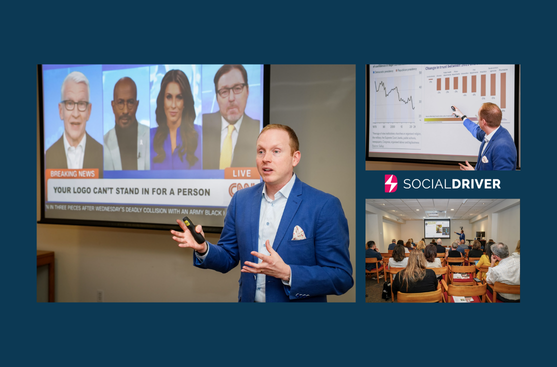
The organizations winning in health advocacy right now share one thing in common: their leaders have stopped waiting to be discovered.
At the National Health Council's 2026 Leadership Conference, Anthony Shop, Co-Founder and Chief Strategy Officer at Social Driver, led a pre-conference workshop for healthcare CEOs and board chairs on what authentic executive visibility actually requires. The room was filled with CEOs and board chairs of nonprofits focused on patient advocacy. What surfaced was a shift in thinking that more health leaders are arriving at: your face, your voice, and your perspective are organizational assets. How you use them, or don't, has strategic consequences.
The TV Station Problem
Here's a pattern most health leaders recognize instantly. If a TV station calls a CEO, they will move mountains to get there. Cancel things. Clear the calendar. Because the reach matters, and they know it.
But ask that same CEO about their personal brand on LinkedIn, and they'll often say, “My comms team handles our company page.”
Here’s the problem: You can't send your logo to a TV station, you have to send a person. And LinkedIn works the same way. People trust people. And platforms like LinkedIn prioritize content from people, not institutions. The leaders who haven't internalized that yet are leaving real influence on the table.
Why This Matters Specifically in Health
We live in a time where people mistrust institutions, governments, and systems. But people still trust people. For health leaders trying to advance the best solutions, whether those are policy changes, funding priorities, or direct patient advocacy, breaking through that noise isn't optional. It's the job.
The media landscape is also more fragmented than ever. Getting on one TV show isn't going to reach all the right people anymore. What works is many spokespeople connecting with many audiences. And that kind of distributed influence starts at the top.
LinkedIn is where the partners, funders, journalists, and policymakers who matter to these organizations are already spending time. It's the most trusted social network and the right starting point for building the kind of reach that compounds over time.
What the Leaders Who “Get It” Have in Common
They've embraced their role as a Chief Influencer. And here's the distinction that matters: someone else had to play a role in making a person a CEO, a U.S. Senator, an Ambassador or a board chair. They were hired, elected, or appointed. But only that leader can choose to leverage the power of their personal influence to advance a mission larger than themselves. No board can make that decision for them.
A few examples from the room made this concrete:
What they share isn't a posting frequency or a content format. It's a decision to show up.
Four Things We Have Learned from 130+ Chief Influencer Interviews
The workshop drew on lessons we have gathered from interviewing more than 130 leaders through the Chief Influencer podcast. These Founders, CEOs, U.S. Senators and Ambassadors have very different jobs but a lot in common. Four themes emerged from those conversations that any leader can apply:
A Note on the Self-Promotion Trap
One of the most common hesitations health leaders bring to this conversation is the worry about appearing self-promotional. Our answer: that instinct is actually a great sign.
The goal was never to be that person with the megaphone in the corner of the networking event. The goal is to show up the way you would at a conference: join conversations, listen, comment on what colleagues are sharing, express gratitude, give people who couldn't be in the room a behind-the-scenes look at what you're learning.
If you're not sure where to start: try gratitude. Thank the people who made something possible. Feature a colleague's work. Share an insight from an event you attended. That kind of content doesn't feel like self-promotion, because it isn't. And it tends to get more engagement, too.
One Step Forward
The advice from the workshop wasn't one-size-fits-all, because it can't be. Someone in the room might be polishing a high-performing profile. Someone else might not remember their LinkedIn password.
The message was the same for both: take stock of where you are, figure out your “why,” and then just take one step toward it. If every health leader in that room took one step, that's a lot of steps forward, together.
Faces are the new logos. It's not a metaphor. It's a description of how trust is built in 2026. And the leaders who act on that first have a real advantage: they're earning the credibility that takes time to build, while their peers are still deciding whether it's worth the effort.
What This Means for Your Organization
Executive visibility doesn't happen by accident and it doesn't scale on its own. It requires a strategy, a system, and the willingness to show up as who you actually are, not a polished institutional version of yourself.
Social Driver works with health organizations and their leaders to build executive visibility programs that are strategic, sustainable, and rooted in the mission. If you're ready to build that architecture, reach out.


.png)
.png)